How to Budget on an Irregular Income
A Simple Guide for 1099 Earners and Gig Workers
Budgeting on an irregular income is not a math problem—it is a cash flow timing problem. Traditional budgets assume your money arrives like clockwork every two weeks with taxes already withheld, but freelance gigs, client contracts, and delivery platforms do not follow a predictable calendar.
The secret to mastering variable income is decoupling what you spend today from what you earned yesterday. By setting a baseline survival floor, quarantining taxes the second a payment clears, and paying yourself a fixed monthly “salary” from a separate holding account, you can eliminate the feast-or-famine stress and make erratic 1099 earnings feel as dependable as a traditional corporate paycheck.
Why Traditional Budgets Break for Freelancers and Gig Workers
Most budgeting advice is designed for W-2 (Wage and Tax Statement) employees who receive predictable net paychecks. If your take-home pay is always $2,200 on the 1st and the 15th, planning a static monthly spending plan is straightforward arithmetic.
If you work as an independent contractor receiving Form 1099-NEC (Nonemployee Compensation) or platform payouts reported on Form 1099-K (Payment Card and Third Party Network Transactions), your income swings based on seasonal demand, client approval cycles, and hours worked. More critically, companies do not withhold taxes from your pay. Receiving 100% of your gross earnings creates the dangerous illusion that you have more spendable cash than you actually do.
When a good month brings $6,500 and a slow month drops to $1,800, a rigid budget fails. You either overspend during the boom or lean on high-interest credit cards during the slump. To take control, you need an operational cash flow system built specifically for income volatility.
Next Step: Review your bank statements from the last four to six months. Do not worry about categorizing individual line items yet—simply note your highest-earning month and your lowest-earning month to determine your volatility spread.
Step 1: Calculate Your “Bare-Bones” Baseline Floor
Before allocating money toward lifestyle goals, vacations, or extra investments, you must pinpoint your exact survival number. This is the minimum amount of cash required each month to cover your non-negotiable living expenses: shelter, utilities, essential groceries, work transportation, and minimum debt payments.
We call this your Bare-Bones Budget. It strips away restaurant takeout, streaming subscriptions, and discretionary retail. Knowing this number gives you instant psychological relief: it represents the exact dollar benchmark your business or gig work must clear each month to keep you afloat without adding new debt.
Next Step: Add up your five non-negotiable categories using your actual receipts from last month. Write down your total baseline survival number where you can see it regularly.
Step 2: Build the 4-Account Cash Flow Waterfall
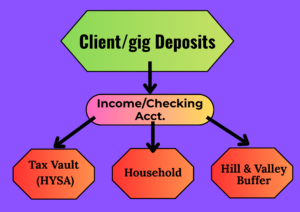
Illustration of the cash flow waterfall concept.
The single most destructive habit among 1099 earners is depositing gig payouts, client checks, tax money, and grocery cash into one single personal checking account. When all your money sits in one pool, you cannot tell what is safe to spend, what belongs to the government, and what is needed for next month’s rent.
To eliminate this confusion, set up an automated 4-account waterfall using free online checking and savings sub-accounts:
- 1. The Income Holding Tank (Business Checking): Every client invoice, direct deposit, and app payout lands here first. You never swipe a debit card or pay personal bills out of this account.
- 2. The Tax Vault (HYSA): A dedicated HYSA (High-Yield Savings Account) where tax reserves sit untouched until quarterly payment dates.
- 3. The Hill-and-Valley Buffer (HYSA): A cash reserve designed to stockpile excess earnings during high-income months and bridge shortfalls during lean months.
- 4. The Household Operating Account (Personal Checking): Your everyday personal account where you receive a predictable “paycheck” to cover family living expenses.
ℹ️ Why High-Yield Accounts Protect Your Reserves:
Keeping your Tax Vault and Hill-and-Valley Buffer in an HYSA ensures your idle cash earns full market interest while staying completely liquid. Verify that your chosen institution is backed by the FDIC (Federal Deposit Insurance Corporation) or NCUA (National Credit Union Administration) to ensure your deposits are insured up to legal limits.
Next Step: Log into your primary banking app and open two dedicated sub-savings accounts labeled “Tax Vault” and “Hill-and-Valley Buffer.”
Step 3: Quarantine Taxes on Day One
As an independent contractor, you are responsible for paying both the employer and employee portions of Social Security and Medicare taxes. This is the self-employment tax, which sits at a statutory rate of 15.3% on net self-employment earnings, alongside your ordinary federal and state income taxes.
The moment any payment lands in your Income Holding Tank, immediately transfer 25% to 30% straight into your Tax Vault. If an invoice clears for $1,200, move $300 to $360 into your Tax Vault before budgeting a single dollar for business software, personal bills, or entertainment. Treat that money as if it was never yours.
⚠️ Avoid the IRS Underpayment Penalty:
The IRS (Internal Revenue Service) requires most self-employed individuals expecting to owe $1,000 or more in annual taxes to make quarterly estimated payments using Form 1040-ES. Waiting to pay your entire tax bill on April 15 can trigger costly underpayment penalties and interest charges, even if you pay your total balance in full on tax day.
Set calendar reminders for the standard IRS quarterly estimated tax deadlines:
- April 15 (First quarter earnings: Jan 1 – Mar 31)
- June 15 (Second quarter earnings: Apr 1 – May 31)
- September 15 (Third quarter earnings: Jun 1 – Aug 31)
- January 15 (Fourth quarter earnings: Sep 1 – Dec 31)
Next Step: Calculate 30% of your most recent client payment or gig deposit, and transfer that exact amount into your Tax Vault today.
Step 4: Pay Yourself a Predictable “Salary” (The Owner’s Draw)
Once taxes are cordoned off in your Tax Vault, you can stabilize your household finances. Instead of transferring erratic lump sums into your personal checking account whenever you run low on cash, pay yourself a consistent biweekly or monthly “salary” (also known as an owner’s draw).
How to Set Your Salary Target
Base your salary on your bare-bones survival floor plus a modest cushion for day-to-day comfort. If your baseline floor is $2,600 and a typical lifestyle month costs $3,000, set your draw at $2,800 or $3,000. Schedule a recurring transfer from your Income Holding Tank to your Household Operating Account on the 1st and 15th of each month (e.g., $1,500 per transfer).
Managing a “Feast” Month ($5,200 Net After Taxes)
- Your income account receives $5,200 after taxes.
- You transfer your standard $3,000 salary to your Household Operating Account.
- The remaining $2,200 surplus does not get spent. It moves directly into your Hill-and-Valley Buffer.
Managing a “Famine” Month ($1,900 Net After Taxes)
- Your income account brings in only $1,900 after taxes.
- You still need your standard $3,000 salary to cover personal expenses without stress.
- Transfer the $1,900 from your holding account, then withdraw the remaining $1,100 directly from your Hill-and-Valley Buffer.
- Your household bills are paid on time, your credit score is protected, and your daily life remains completely stable.
🎉 The Freelance Gold Standard: Living on Last Month’s Income
When your Hill-and-Valley Buffer reaches one full month of operating expenses, you achieve the ultimate independent milestone: funding April’s life entirely with money earned and cleared in March. Invoicing delays and late client payments stop feeling like financial emergencies.
Next Step: Pick a fixed owner’s draw amount based on your baseline floor, and schedule your first fixed transfer for this coming Friday.
Connecting Your Cash Flow to Long-Term Wealth
When you transform variable gig revenue into a predictable personal salary, the rest of your financial life falls neatly into place. You can now implement proven wealth-building strategies without fear of cash shortages:
- Organize Personal Spending: Apply structured frameworks like The 50/30/20 Budget to your personal operating account, allocating 50% of your draw to needs, 30% to wants, and 20% to personal savings.
- Establish Sinking Funds: Set aside small monthly amounts for irregular business expenses (annual software renewals, quarterly insurance premiums, quarterly car maintenance) so they never compete with your personal salary.
- Build a True Emergency Reserve: Remember that your Hill-and-Valley Buffer is for income volatility, not unexpected personal crises. Review our guide on Starting an Emergency Fund from Scratch to build an independent 3-to-6 month personal safety net.
💡 Advice & Pro-Tip: Open Accounts at Separate Institutions
If you struggle with the temptation to spend money when you see it on your screen, hold your Tax Vault and Hill-and-Valley Buffer at a completely different online bank than your daily checking account. Removing tax money from your daily line of sight eliminates impulse transfers.
📌 Quick Takeaway: The 1099 Cash Flow Action Plan
1. Calculate your floor: Add up rent, utilities, food, transport, and debt minimums to find your baseline.
2. Separate your accounts: Run revenue through an Income Holding Tank, not your personal checking account.
3. Quarantine 25%–30% for taxes: Transfer tax money to your Tax Vault the day a deposit clears.
4. Pay yourself a salary: Transfer a fixed amount twice a month; let the Hill-and-Valley Buffer smooth out the peaks and valleys.
TalkBudget provides general educational content and is not a registered financial advisor or CPA (Certified Public Accountant). Please consult a qualified professional before making major financial decisions.
Leave a Reply