Budgeting Foundations
Core budgeting ideas, starter kits and habit tracking for beginners.
Sticking to a Budget
Sticking to a budget is rarely a willpower problem; it is almost always an engineering problem. Most Americans do not abandon their financial plans because they lack discipline or ambition. They abandon them because traditional budgeting advice demands robotic perfection in an unpredictable world. When an unexpected car repair hits, or a long week leads to takeout dinners, a rigid plan shatters, leading to guilt, budget fatigue, and total abandonment.
According to data from the Federal Reserve, more than a third of American adults would struggle to cover an unexpected $400 emergency expense with cash. When every extra dollar is tightly cordoned off without room to breathe, even a minor surprise blows the entire monthly plan apart. Real-world financial success is not about white-knuckling your way through extreme deprivation—it is about designing resilient systems that make staying on a budget the path of least resistance.
◈ Key Takeaway: The Three Laws of Budget Adherence
- Automate the non-negotiables: Separate fixed bills and savings from daily variable cash using independent accounts.
- Build structural shock absorbers: Include an unallocated monthly buffer ($100–$200) and dedicated sinking funds so surprises do not derail your core plan.
- Inject tactical friction: Neutralize instant online checkout and retail marketing triggers before willpower gets tested.
If you have already laid your foundation using our step-by-step walkthrough on how to start budgeting, this guide provides the missing operational blueprint. Below, we break down the behavioral psychology of overspending, examine tactical friction methods, establish bulletproof banking firewalls, and walk through a 15-minute weekly routine designed to keep your money on track permanently.
1. The Psychology of Overspending (Why Your Brain Fights Your Budget)
To master spending management, you must first understand that modern retail environments are intentionally engineered by behavioral scientists to bypass your rational prefrontal cortex. Understanding the psychological reasons for overspending removes personal shame and allows you to build targeted defenses.
The Dopamine Seeking Loop & Digital Friction Removal
Anticipation drives human behavior. When you browse an online store or view a limited-time flash sale, your brain releases dopamine—the neurotransmitter responsible for motivation and reward-seeking. Crucially, dopamine spikes during the hunt and the anticipation of buying, not after the purchase is completed. Once the package arrives on your doorstep, the neurochemical surge fades, often replaced by buyer’s remorse.
E-commerce platforms amplify this loop by systematically eliminating payment friction. Features like one-click checkout, saved credit card autofill in browsers, Apple Pay, and Buy Now, Pay Later (BNPL) installment loans separate the pleasure of acquiring an item from the immediate pain of parting with cash. When friction drops to zero, impulse spending climbs.
The “What-the-Hell” Effect (Counterregulatory Behavior)
In behavioral economics, counterregulatory spending describes what happens when a small slip turns into a total collapse. If you budget $150 for a weekly grocery run but end up spending $172, a perfectionist mindset triggers an internal reaction: “Well, I’ve already blown the budget for this week, so what the hell—I might as well order delivery tonight and buy those shoes I was looking at.”
Keeping to a budget requires treating spending limits like highway guardrails, not razor-thin balance beams. Bumping into a guardrail means you make a minor steering adjustment; it does not mean you drive off the bridge.
Decision Fatigue and the Depletion of Willpower
Willpower is a finite cognitive resource that depletes over the course of a day. Every decision you make at work, every email you answer, and every traffic jam you navigate drains your mental battery. If your financial plan relies entirely on saying “no” through sheer willpower at 8:00 PM on a Friday after an exhausting 50-hour workweek, the plan will fail. Staying on a budget requires shifting the burden away from daily active willpower and onto passive, automated systems.
🔷 Behavioral Concept: The Pain of Paying
Studies pioneered by researchers at MIT and Carnegie Mellon show that paying with physical cash activates the insula—the brain region linked to physical discomfort and pain. Swiping a credit card or tapping a phone significantly dampens this insular response. To curb spending, you must deliberately re-insert artificial friction into digital payment channels.
2. Tactical Friction: How to Stop Overspending Before It Starts
If you regularly ask yourself, “how do I stop overspending when temptation is everywhere?”, the answer lies in environmental design. You do not change your fundamental desires overnight; you change your immediate spending environment to make impulsive decisions difficult and deliberate decisions easy.
The Digital Purge: De-Linking Frictionless Payment Rails
Take 20 minutes today to execute a digital declutter across your devices:
- Remove Saved Cards from Browsers: Clear stored credit and debit card numbers from Google Chrome, Safari, and Autofill settings. Forcing yourself to physically stand up, find your wallet, and manually type in a 16-digit card number gives your logical brain time to intervene.
- Unlink 1-Click Ordering: Turn off instant purchasing options inside online marketplace apps like Amazon, eBay, and Target.
- Disable Fast Mobile Wallets for Non-Essentials: If food delivery or ride-sharing apps trigger overspending, disconnect Apple Pay, Google Wallet, or PayPal from those accounts.
- Unsubscribe from Retail Newsletters: Marketing emails claiming a “48-Hour 40% Off Flash Sale” manufacture artificial urgency for items you did not need ten minutes earlier. Use an email filter to bulk-unsubscribe or route commercial promotions into a separate folder you only open during planned shopping trips.
The 72-Hour Rule & The “Hours of Labor” Translation
For any non-essential purchase exceeding $50, implement a mandatory 72-hour cooling-off window. When you feel the urge to buy, bookmark the item or add it to a “Saved for Later” wish list. Step away completely. More than half of all impulse desires dissolve once the initial dopamine spike subsides over three days.
If you still want the item after 72 hours, translate its price tag into real hours of your life rather than abstract dollars. Divide the retail price by your true hourly net wage (what you earn per hour after federal, state, and FICA payroll deductions):
◈ Example: Calculating True Labor Cost
Assume your net take-home pay is $3,200 per month across 160 working hours ($20.00/hour net).
You want a new designer jacket priced at $180.
Calculation: $180 / $20 = 9 full hours of work.
Ask yourself: Is this jacket worth spending from 8:30 AM to 5:30 PM on a Monday working solely to pay for it?
Targeted Friction Protocols by Spending Category
Different spending triggers require different interventions. Use the table below to deploy specific counter-measures based on where your money tends to leak:
3. Structural Fixes: Engineering a Failure-Proof Financial Firewall
One of the primary reasons people fail at stay on budget efforts is co-mingling funds. When your rent money, utility bills, emergency savings, and weekend entertainment allowance all sit inside a single checking account, you are forced to do complex mental math every time you glance at your account balance.
The Dual-Checking “Firewall” Architecture
To eliminate mental math and prevent accidental overspending on fixed obligations, separate your cash flow physically across two separate checking accounts at your bank or credit union:
- Account #1: Fixed Bills & Obligations Checking: This account handles all non-negotiable living costs—mortgage/rent, utilities, auto insurance, minimum debt payments, child care, and internet. Direct deposit routes the exact amount needed for monthly fixed bills directly here. You never carry the debit card for this account in your wallet.
- Account #2: Variable Lifestyle & Daily Spending Checking: This account receives your discretionary allowance for groceries, dining out, gas, clothing, and entertainment. When you open your banking app to see what you can spend on Saturday night, the balance you see is 100% safe to spend. If the balance reaches $0, discretionary spending stops until the next pay cycle—without endangering your rent.
🟣 Pro-Tip: The Automated Payday Split
Most employer payroll portals allow you to split your direct deposit into multiple destination accounts. Route your fixed bill total into Account #1, your target savings percentage directly into an FDIC-insured High-Yield Savings Account (HYSA), and the remaining variable balance into Account #2. Your budget executes itself automatically before you ever log in.
Sinking Funds: Neutralizing “Surprise” Irregular Bills
Irregular expenses are not genuine emergencies. Your car will eventually need new tires. Your annual Amazon Prime membership will renew. Your dog will need vaccinations. The holidays arrive every December 25th like clockwork.
When you treat predictable, irregular costs as sudden emergencies, they destroy your confidence and force you onto credit cards. The solution is the systematic use of sinking funds. A sinking fund is simply a savings sub-category where you save a small amount each month for a specific future expense.
To calculate a sinking fund allocation, divide the expected total bill by the number of months until it is due:
The $150 “Oops” Line Item (Zero-Guilt Cushion)
Human beings cannot forecast 30 days of expenses with penny-perfect precision. A sudden school fee arises, gas prices spike 20 cents per gallon, or you run out of laundry detergent and olive oil in the same week.
Instead of assuming zero margin for error, build an intentional $100 to $200 “Oops Buffer” into every monthly spending plan. If minor miscellaneous expenses arise, they absorb into this cushion without impacting your core categories. If you reach the final day of the month with the buffer untouched, you can sweep that balance directly into savings or apply it toward debt reduction.
4. Choosing Your System: App, Planner, or Spreadsheet?
A tracking system must fit your psychological preference, not someone else’s aesthetic. If an author tells you that you must use a complex spreadsheet, but opening Excel gives you anxiety, you will abandon it within two weeks. If you are debating which strategy fits your personality, check our comparison where we tested every popular budgeting method for 90 days.
Here is how to select the right platform to manage personal finance day-to-day:
5. The 15-Minute Sunday Money Date (Weekly Maintenance Routine)
Budgets do not break in monthly increments; they break in weekly increments. Waiting until the 31st of the month to review your transactions is an autopsy; reviewing them weekly is active steering.
Set a recurring calendar event every Sunday morning for a 15-minute “Money Date.” Grab a cup of coffee and complete this four-step checklist:
- Step 1: Reconcile Pending and Cleared Transactions (4 Minutes)
Log into your financial tool or spreadsheet and match all transactions from the past 7 days. Ensure no unrecognized subscriptions, duplicate merchant charges, or fraudulent transactions slipped through. - Step 2: Balance the Buckets via the “Rule of Reallocation” (4 Minutes)
Did you overspend on dining out by $35 this week? Do not panic, and do not abandon the budget. Simply reallocate $35 from an underspent category (like clothing or your “Oops Buffer”) to balance the ledger back to zero. A budget is a living, breathing allocation roadmap, not stone tablets. - Step 3: Preview the Upcoming 7-Day Social Calendar (5 Minutes)
Look at your work and personal calendar for the week ahead. Is there a birthday party on Thursday? A work lunch on Tuesday? An oil change scheduled for Friday? Adjust your spending allocations today so that these planned events do not surprise you midweek. - Step 4: Identify and Celebrate One Weekly Win (2 Minutes)
Did you cook four meals at home? Did you negotiate $15 off your internet bill? Did you avoid an impulse purchase during a flash sale? Acknowledging positive progress releases dopamine, reinforcing the healthy habit loop for the coming week.
◈ Sunday Money Date Quick Reference Card
◻ Log & Categorize: Confirm all 7-day card transactions.
◻ Rebalance: Cover category deficits from surplus categories.
◻ Calendar Forecast: Check the next 7 days for birthdays, travel, or bills.
◻ Micro-Win: Note one positive financial choice made this week.
6. Living on a Budget with a Partner or Family
Living on a budget as an individual is straightforward; doing so with a spouse, partner, or family introduces competing priorities, different money mindsets, and emotional complexity. According to relationship surveys, money disagreements remain a leading cause of marital stress.
The “Yours, Mine, and Ours” Hybrid System
Total financial fusion can cause tension over minor purchases, while complete financial separation often hinders progress toward large joint goals like buying a home or funding retirement. The most sustainable architecture for couples is the hybrid account system:
- The Joint Account (“Ours”): Both partners contribute an agreed-upon dollar amount or percentage of their income into a shared account. This fund covers the mortgage/rent, utilities, groceries, joint savings goals, and child expenses.
- Individual Fun Accounts (“Yours” & “Mine”): Each partner receives an equal monthly personal allowance transferred into their own separate checking accounts. This money is 100% discretionary with zero oversight required.
🟢 Relationship Rule: The “No-Questions-Asked” Allowance
Establish a strict monthly dollar amount (e.g., $100–$250 each) that each partner can spend entirely on whatever they want—video games, cosmetics, golf outings, or vintage collectibles—without needing permission, justification, or guilt. Autonomy preserves harmony.
The “Large Purchase Notification” Threshold
Agree together on a mutual threshold for joint expenditures (e.g., any non-essential purchase over $150 requires a brief 2-minute conversation before buying). This simple boundary eliminates unexpected credit card statement shocks while preserving everyday operational trust.
7. The Emergency Recovery Protocol (What to Do When You Blow Your Budget)
Every experienced budgeter eventually blows a category. You travel for a wedding, get hit with high surge-pricing on rideshares, buy multiple rounds of drinks, and suddenly find yourself $300 in the red.
Novice budgeters respond with shame and give up entirely. Experienced financial managers execute a damage control protocol:
🔴 Beware: The “Starvation Rebound” Trap
Never attempt to “punish” yourself for overspending by cutting your grocery or living budget down to zero for the following two weeks. Financial starvation diets lead to severe willpower depletion, almost guaranteeing another massive spending binge shortly after.
The 3-Step Recalibration Playbook
- Step 1: Execute a 48-Hour Discretionary Freeze
Stop the bleeding immediately. Commit to spending $0 on non-essential categories for exactly 48 hours. This pauses emotional momentum and clears the cognitive fog of a financial slip. - Step 2: Conduct a Blameless Trigger Audit
Ask yourself objective questions: Was the overspending caused by an unrealistic original estimate? An unexpected social pressure? An emotional reaction to work stress? Identify the true root cause without self-blame so you can engineer a structural guardrail around it next time. - Step 3: Spread the Adjustment Across Multiple Buckets
If you are over by $200, do not eliminate one entire category. Trim $40 from dining out, $30 from entertainment, $30 from personal shopping, and pull $100 from your monthly “Oops Buffer” or emergency fund. Distributing the adjustment keeps every category functional.
Consistency Beats Perfection
A successful financial life is not built on a single month of flawless discipline. It is built across years of continuous, flexible adjustments. Sticking to a budget is like navigating a ship: crosswinds and waves will push you off course every single week. Your job is not to prevent the wind from blowing; your job is simply to check your compass, adjust your rudder during your Sunday Money Date, and keep sailing forward.
Editorial Disclaimer: TalkBudget provides general educational content and is not a registered financial advisor or CPA. Financial situations vary widely based on individual circumstances, local tax regulations, and evolving market conditions. Please consult a qualified professional before making major financial decisions.
How To Start Budgeting
Budgeting is not a financial crash diet. It is not about depriving yourself of every latte, canceling dinner with friends, or living in an empty apartment eating plain ramen. When done correctly, a budget is simply an intentional spending plan that gives you guilt-free permission to spend money on what actually matters to you while quietly building your wealth in the background.
If you have ever reached the end of the month and wondered where your hard-earned paycheck vanished, you are not alone. Over 60% of Americans live paycheck to paycheck, including a significant percentage of six-figure earners. The problem is rarely a lack of income; it is the absence of a clear, automated allocation system. Without a plan, money leaks out through subscription creep, impulse shopping, and surprise expenses.
This comprehensive, step-by-step guide will walk you through building your very first workable budget from scratch. We will audit your real cash flow, match you with the right budgeting framework, tame unpredictable expenses, and automate your finances so your money starts working for you—not the other way around.
📌 The 5 Golden Rules of Budgeting That Actually Works
1. Base your numbers on net pay (what actually hits your checking account, not your gross salary).
2. Cover the “Core Four” first (shelter, utilities, basic groceries, and essential transportation).
3. Build a $1,000 starter buffer in a High-Yield Savings Account (HYSA) before making aggressive financial moves.
4. Plan for irregular bills using monthly “sinking funds” so annual expenses never feel like emergencies.
5. Give yourself guilt-free fun money to keep your budget sustainable over the long haul.
Phase 1: The 60-Day Financial Reality Audit
Before you can decide where your money should go, you need an honest, judgment-free snapshot of where it is currently going. Most beginners make the mistake of creating an aspirational budget based on how they wish they spent money. That approach almost always falls apart by day fourteen. Instead, we start with hard data.
Step 1.1: Calculate Your Real Net Take-Home Pay
Your gross salary looks impressive on an offer letter, but you cannot pay your rent with money you never received. Your starting budget number must always be your net take-home pay—the exact dollar amount deposited into your checking account after all deductions.
These payroll deductions typically include:
- Federal, State, and Local Income Taxes: Mandatory withholdings determined by your W-4 form.
- FICA Taxes: Mandatory 6.2% Social Security and 1.45% Medicare contributions.
- Pre-Tax Benefits: Employer-sponsored health, dental, and vision insurance premiums.
- Pre-Tax Retirement Contributions: Traditional 401(k) or 403(b) contributions, as well as Health Savings Account (HSA) or Flexible Spending Account (FSA) allocations.
Also, pay close attention to your pay frequency schedule:
- Bi-Weekly (Every 2 Weeks): You receive 26 paychecks per year. That means 10 months have two paychecks, and two “magic” months have three paychecks. Build your base monthly budget around two paychecks, treating the third paycheck as an instant bonus for savings or debt payoff.
- Semi-Monthly (Twice a Month): You receive 24 paychecks per year, typically on the 1st and 15th (or 15th and last business day). Your monthly income remains identical every month.
- Weekly (Every Week): You receive 52 paychecks per year. Multiply your average weekly paycheck by 4.33 to calculate your baseline monthly cash flow.
⚠️ Beware: The “Gross Income Trap”
If you earn a $60,000 annual salary, your monthly gross pay is $5,000. However, after taxes, insurance, and a modest 5% 401(k) contribution, your actual monthly deposit might only be $3,650. Writing a budget based on $5,000 creates an immediate $1,350 phantom deficit that guarantees failure before you even start.
Step 1.2: The 60-Day Transaction Lookback
Log into your online bank and credit card accounts and download your statements for the last 60 days. Open a clean spreadsheet or grab a notebook and categorize every single transaction into one of two buckets:
- Fixed Expenses: Bills that remain virtually identical every billing cycle (rent/mortgage, auto insurance, internet, car payment, student loan minimums, gym membership).
- Variable Expenses: Costs that fluctuate depending on your choices and lifestyle (groceries, restaurant meals, gas, rideshares, clothing, personal care, entertainment).
Step 1.3: Uncover “Phantom Spending” and Subscription Creep
As you review your statements, highlight recurring micro-transactions. It is easy to ignore a $9.99 streaming app, a $4.99 cloud storage upgrade, or an annual $119 subscription renewal, but together they quietly drain hundreds of dollars per month. List every active subscription, cancel the ones you have not used in the last 30 days, and total up what is left. This forms your real baseline spending.
Phase 2: Choose Your Budgeting Framework
There is no single “correct” way to budget. The best budgeting system is the one you can stick with consistently for six months without wanting to tear your hair out. Here are the four proven budgeting frameworks used by personal finance experts:
1. The 50/30/20 Rule (The Balanced Baseline)
Created by Senator Elizabeth Warren, this method divides your net take-home pay into three broad percentages.
- 50% for Needs: Essential living expenses (housing, utilities, groceries, transportation, minimum debt payments, health insurance).
- 30% for Wants: Discretionary lifestyle spending (dining out, streaming services, concerts, travel, hobbies).
- 20% for Savings & Extra Debt Payoff: Building an emergency fund in an HYSA, investing for retirement (Roth IRA), and paying down high-interest credit card debt.
Best for: Beginners, busy professionals, and anyone who wants financial structure without tracking every coffee purchase.
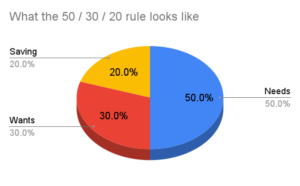
What 20/30/50 budget looks like as a pie
2. Zero-Based Budgeting (The Precision Plan)
Popularized by financial author Dave Ramsey and software like YNAB (You Need A Budget), Zero-Based Budgeting assigns every single dollar a specific job until your income minus your planned allocations equals exactly zero: Income - Expenses - Savings = $0.
If your monthly take-home pay is $4,000, all $4,000 is distributed across fixed bills, variable categories, sinking funds, debt payoff, and savings. Not a single dollar is left floating aimlessly in your checking account.
Best for: Aggressive debt elimination, analytical personalities, and anyone who feels their money constantly slips through their fingers.
3. Pay-Yourself-First / Reverse Budgeting (The Minimalist Route)
Instead of categorizing every line item, you immediately divert your target savings and investment amount out of your paycheck the day you get paid (e.g., sending $600 to an HYSA and a Roth IRA). Once your fixed bills and savings are covered, you are completely free to spend whatever balance remains in your checking account on whatever you want, guilt-free.
Best for: People who hate tracking daily receipts and simply want to ensure their future is funded without micro-managing line items.
4. The Envelope System / Digital Cash-Stuffing
This classic method involves setting strict cash spending limits for high-risk categories like groceries, dining out, and entertainment. You withdraw physical cash on payday and place it into labeled envelopes. Once an envelope is empty, spending in that category stops completely until the next month. Modern digital equivalents use separate checking sub-accounts or debit cards with balance alerts.
Best for: Chronic overspenders, people breaking a credit card dependence, and hands-on tactile learners.
💡 Free Tool: Download Our Starter Budgeting Spreadsheet Pack
Not sure where to start? Grab our free TalkBudget Starter Spreadsheet Pack. It includes automated templates for both the 50/30/20 Rule and Zero-Based Budgeting in Google Sheets and Microsoft Excel format. Simply plug in your income and the formulas handle the math automatically. Find it at the end of the article!
Phase 3: Step-by-Step Construction of Your First Monthly Budget
Now it is time to build your actual numbers. Whether you are using a spreadsheet, an app, or a notebook, follow this sequential hierarchy to assemble your spending plan:
Step 3.1: Secure the “Core Four” Non-Negotiables First
If you lose your job or experience an unexpected financial emergency, your money must protect four essential pillars before anything else:
- Shelter: Rent or mortgage payment, HOA fees, and property taxes. Aim to keep housing costs under 28–30% of your net take-home pay whenever possible.
- Utilities: Electricity, natural gas, heating oil, water, sewer, and a basic mobile phone/internet plan.
- Basic Food: Nutritious, home-prepared groceries. Exclude fancy restaurant meals, daily work lunches, and high-end delivery services from this baseline.
- Essential Transportation: Basic auto loan payment, gasoline, public transit pass, auto insurance, and basic maintenance required to commute to work.
Step 3.2: Build Your $1,000 “Shock Absorber” Cushion
Before putting every spare penny toward aggressive debt payoff or long-term investments, establish an initial $1,000 Starter Emergency Fund. Keep this cash parked in a dedicated, FDIC-insured High-Yield Savings Account (HYSA) separate from your day-to-day checking account.
Why? Because life happens. A blown car tire, a plumbing leak, or an unexpected urgent care co-pay will easily derail a budget if you have no cash reserves, forcing you right back onto high-interest credit cards. This $1,000 buffer turns a financial crisis into a minor inconvenience.
Step 3.3: Master “Sinking Funds” for Irregular Expenses
The number-one reason budgets fail after 60 days is unexpected, non-monthly expenses: semiannual car insurance premiums, annual Amazon Prime renewals, holiday gift shopping, veterinarian checkups, and routine dental cleanings. These are not true emergencies—they are predictable, irregular expenses.
The solution is a sinking fund. Divide the total annual cost by 12 and save that amount every single month:
- Car Insurance ($1,200/year): Save
$100/monthinto your HYSA sinking fund. - Holiday Gifts ($600/year): Save
$50/monthstarting in January. - Home & Car Maintenance ($1,200/year): Save
$100/monthfor routine tune-ups and repairs.
When the bill arrives in October or December, the money is already sitting in your savings account waiting to be spent.
Step 3.4: Protect Your Guilt-Free “Fun Money”
A budget that allows zero fun is doomed from day one. Humans are not spreadsheets; if you build a plan with 0% allocated for recreation, you will eventually burn out and go on an impulsive spending binge. Earmark a dedicated 5% to 10% of your net pay for pure discretionary fun—video games, nice dinners, concert tickets, craft coffee—with zero guilt attached.
Phase 4: Overcoming Real-World Budgeting Roadblocks
A budget on paper is easy; keeping it on track in the real world is where the challenge lies. Here is how to navigate the three most common roadblocks that derail beginner budgets:
Roadblock 1: Budgeting on an Irregular or 1099 Freelance Income
If you are a gig worker, freelancer, real estate agent, or commission-based sales rep, your monthly income fluctuates constantly. Creating a standard static budget based on your best earning month will quickly lead to cash shortfalls during slower periods.
Use the “Holding Tank” Baseline Strategy:
- Determine Your Bare-Bones Baseline: Calculate the minimum monthly cost required to cover your Core Four and minimum debt payments.
- Budget Off Your Worst Month: Look back at your lowest-earning month over the past year. Use that lower figure as your standard monthly spending cap.
- Establish a Tax & Income Buffer Account: Open a dedicated secondary checking or savings account. All client payments land here first. Pay your living expenses like a fixed salary from this account into your personal checking. In fat months, leave the surplus in the holding tank to cushion the lean months.
ℹ️ The 1099 Tax Reserve Rule
If you receive 1099 independent contractor income, no taxes are withheld from your gross checks. Automatically transfer 25% to 30% of every single client payment into a separate savings account reserved exclusively for estimated quarterly IRS and state tax payments. Never include this tax reserve in your spendable household budget.
Roadblock 2: What to Do When Expenses Exceed Income
When you complete your audit, you might discover that your expenses are larger than your paycheck. If your math reveals a monthly deficit, activate the Budget Triage Protocol:
- Level 1 (Immediate Pauses): Temporarily pause all extra debt principal payments and non-essential savings until cash flow is positive. Pay only the minimum balances due on credit cards and personal loans to protect your FICO score.
- Level 2 (Discretionary Slash): Eliminate dining out, cancel unused streaming apps and gym memberships, and meal-plan strictly around grocery store sales.
- Level 3 (Fixed Cost Renegotiation): Call your auto insurance provider to shop your rate or raise your deductible. Call your internet provider to negotiate promotional pricing or drop unnecessary speed tiers. Shop around for lower-cost mobile carriers (like MVNOs).
- Level 4 (Income Acceleration): If structural expenses (like high rent) cannot be immediately cut, bridge the gap with short-term overtime, freelance gig work, or selling unused household items while planning a longer-term career or housing pivot.
Roadblock 3: The Mid-Month Overspend
What happens when you budget $300 for groceries but end up spending $410 by the 20th of the month? Do not abandon your entire budget! Budgeting is a dynamic, living system, not a rigid test of perfection.
Follow the “Roll With the Punches” Principle: When you overspend in one category, balance the ledger by reducing another category. Take $60 from your dining out line and $50 from your clothing or entertainment line to cover the grocery overage. As long as your total monthly outflow remains within your total net take-home pay, your budget is successful.
Phase 5: Automation, Tooling, and Your 15-Minute Maintenance Routine
Manual budgeting fails when it becomes exhausting. The secret to sustaining a budget for years is setting up automated systems that handle the heavy lifting while you live your life.
Step 5.1: Build Your Payday Automation Pipeline
Set up automatic transfers through your employer’s direct deposit or via your bank’s recurring transfer settings to route your income the morning your paycheck arrives:
- 70% remains in your primary Checking Account for bills, groceries, and daily living.
- 15% auto-transfers to your High-Yield Savings Account (HYSA) for emergency funds and sinking funds.
- 10% auto-transfers to your Roth IRA / Brokerage Account for long-term compound growth.
- 5% auto-transfers to a Secondary Discretionary Checking Account for your guilt-free spending debit card.
✅ The Power of Payday Automation
By automating your savings and bill allocations the exact morning your paycheck lands, you remove willpower from the equation. You will naturally adapt your spending to whatever balance remains in your primary checking account without feeling restricted.
Step 5.2: The 15-Minute “Weekly Money Date”
You do not need to log transactions every day. Set a recurring 15-minute calendar invite every Sunday evening or Monday morning to complete this quick checklist:
- Review Account Balances: Check your primary checking and HYSA balances to ensure all expected deposits cleared.
- Reconcile Recent Transactions: Categorize any unassigned expenses in your spreadsheet or budgeting app.
- Check High-Risk Categories: Look at your grocery and entertainment balances for the remaining days in the month.
- Preview Upcoming Calendar Events: Scan your calendar for the upcoming week (birthdays, work trips, dinners out) and make minor category adjustments proactively.
Phase 6: Your 7-Day Budgeting Action Plan
Building a solid financial foundation does not require a full weekend of stress. Take it one simple step at a time over the next seven days:
Join TalkBudget & Get Your Free Pack
Get our free 50/30/20 & Zero-Based templates instantly, plus practical money tips in your inbox.
By subscribing, you agree to receive email updates from TalkBudget. Read our Privacy Policy. Esily unsubscribe anytime in 1 click.
Editorial Disclaimer: TalkBudget provides general educational content and is not a registered financial advisor or CPA. Please consult a qualified professional before making major financial decisions.